
When we talk to customers about a production quote, one of the first questions is: how many SMD components are on the board, and how many THT? For someone outside the industry these abbreviations mean little, yet they have a considerable impact on cost, speed and how production is organised. In this article we explain both technologies in plain language, without assuming the reader has spent a lifetime at an assembly line.
SMD assembly: components on the surface
SMD (Surface Mount Device) components are mounted directly onto the surface of the printed circuit board. They have no long leads passing through holes; instead they have small terminations that sit on the solder pads. This allows them to be very small, and far more of them fit onto the same board area than with the older through-hole technology.
At the heart of SMD assembly are pick-and-place machines, which take components from reels and position them on the board with a precision no human hand can match. At Convel we work exclusively on Yamaha machines, and once placed, the components pass through a reflow oven where the solder paste melts and forms durable joints. The entire process is fast and repeatable, which is why SMD is today the foundation of almost all series production: from consumer electronics to medical devices.
THT assembly: a classic that is not going away
THT (Through-Hole Technology) is the through-hole method: the component has leads that pass through holes in the board and are soldered on the other side. Such a joint is mechanically much stronger, because the part is held to the board not only by the solder but by its whole construction.
This is why THT is far from obsolete. Connectors that someone will plug and unplug hundreds of times, transformers, large capacitors, parts operating at high currents or exposed to vibration, for example in automotive or industrial automation applications, are still most often mounted through-hole. As part of our THT assembly we use both wave soldering, where the board passes over a wave of molten solder, and selective soldering on ERSA equipment, which allows individual points to be soldered precisely without heating the entire board. Some operations, especially with unusual components, are performed by hand by experienced assembly technicians.
In practice: both technologies on one board
A typical electronic device is not a choice of “SMD or THT” but “SMD and THT”. The microcontroller, memory, resistors and capacitors sit on the board as tiny SMD components, and next to them are power connectors, terminal blocks or relays mounted through-hole. Production then proceeds in stages: first the machines place and solder the SMD components, then the board moves on to the THT stations.
From the customer’s point of view this has a practical consequence: the more through-hole and manual operations there are, the greater the share of human labour in the unit cost. Sometimes a small design change, such as swapping a connector for an SMD version, can noticeably reduce the cost of a series. This is one of the things we pick up during our documentation review before production launch.
What happens to the board after assembly
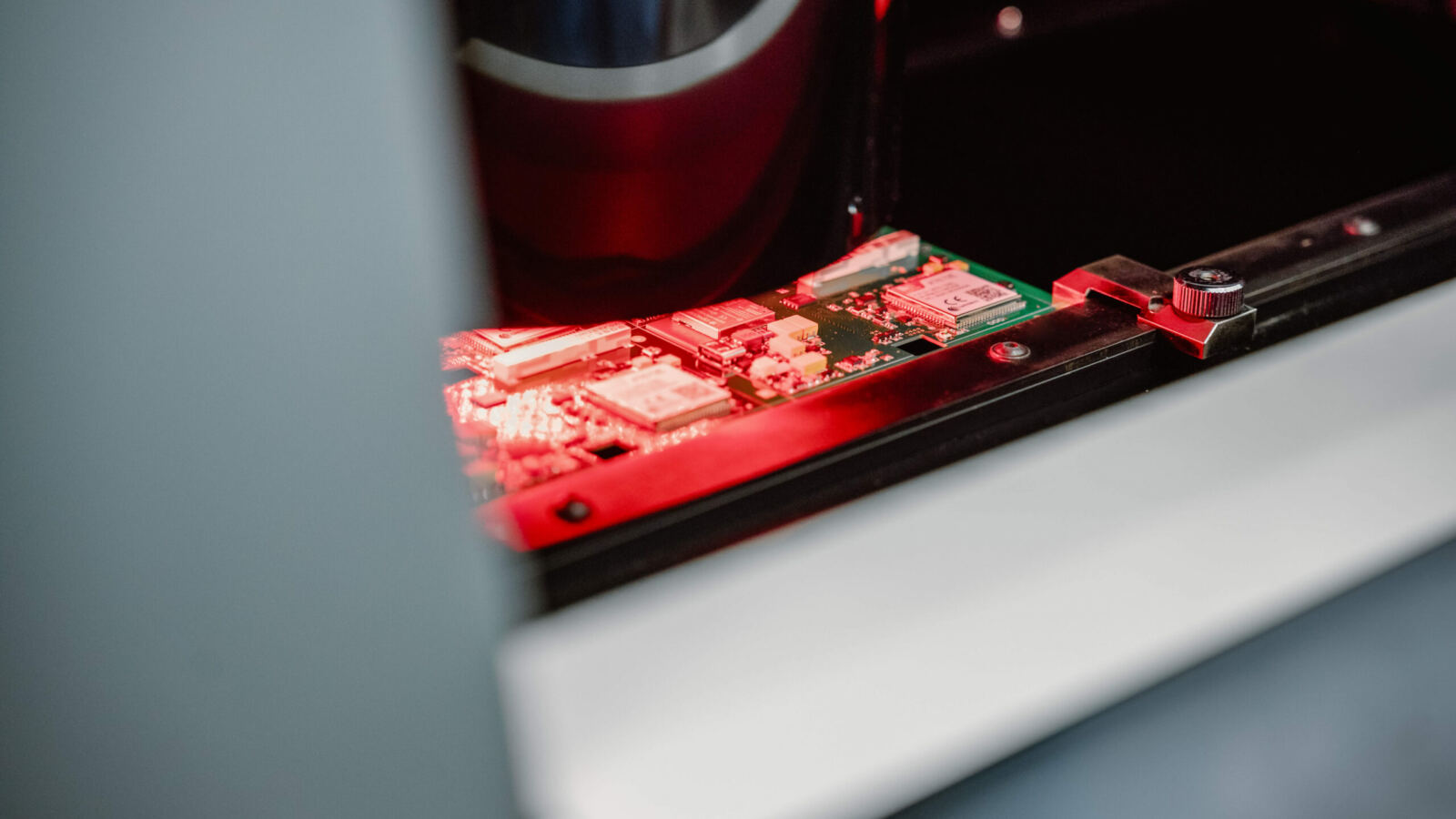
Regardless of the technology, an assembled board does not go straight into a box. Every batch goes through our automated optical inspection (AOI), which compares the board against a reference and catches misaligned components, missing parts or solder defects. We record the inspection results in our production management system, so the history of every batch can be traced. Only after passing inspection do the boards move on to programming, functional testing and the subsequent stages of final assembly.
Where to start if you are planning production
If you have a finished design, all you need is the documentation: the bill of materials (BOM), the board’s production files and the component placement data. On this basis we can assess the share of SMD and THT, suggest any optimisations and prepare a quote. We also provide manufacturing and storage of the bare printed circuit boards as well as component sourcing, so the whole process can stay on our side.
And if you are still choosing a manufacturing partner and want to know what to ask, take a look at our guide on how to choose an electronics contract manufacturer, or simply ask us for a quote.
Let's cost your project
Send us your BOM and Gerber files and we will prepare an assembly quote together with a proposed production schedule. We will also advise on what can be optimised in your design to reduce the unit cost.
Request a quote