
Choosing a contract manufacturer is one of those decisions you make rarely but live with for years. A good EMS partner becomes an extension of your company: it looks after quality, component availability and delivery dates while you focus on sales and product development. A bad partner can sink even a superbly designed device. Below we have gathered the things we believe are worth looking at first, before anyone signs a contract.
Start with the scope: what exactly are you outsourcing
Electronics manufacturing is not a single process but a dozen or more stages that have to mesh together: from purchasing boards and components, through assembly, quality control and firmware programming, to fitting the device into its enclosure and packing it for shipment. Some companies outsource only the assembly itself, while others prefer to hand over the whole chain and receive a finished, packaged product.
It is worth answering honestly at the outset how much of that chain you want to keep in-house. If the manufacturer covers every stage under one roof, as we do at Convel with our complete manufacturing offer, you no longer have to coordinate several subcontractors and shuttle pallets between companies. Every additional link in the chain means another lead time, another risk of transport damage and one more place where responsibility for a defect can become blurred.
The machine park says more than a brochure
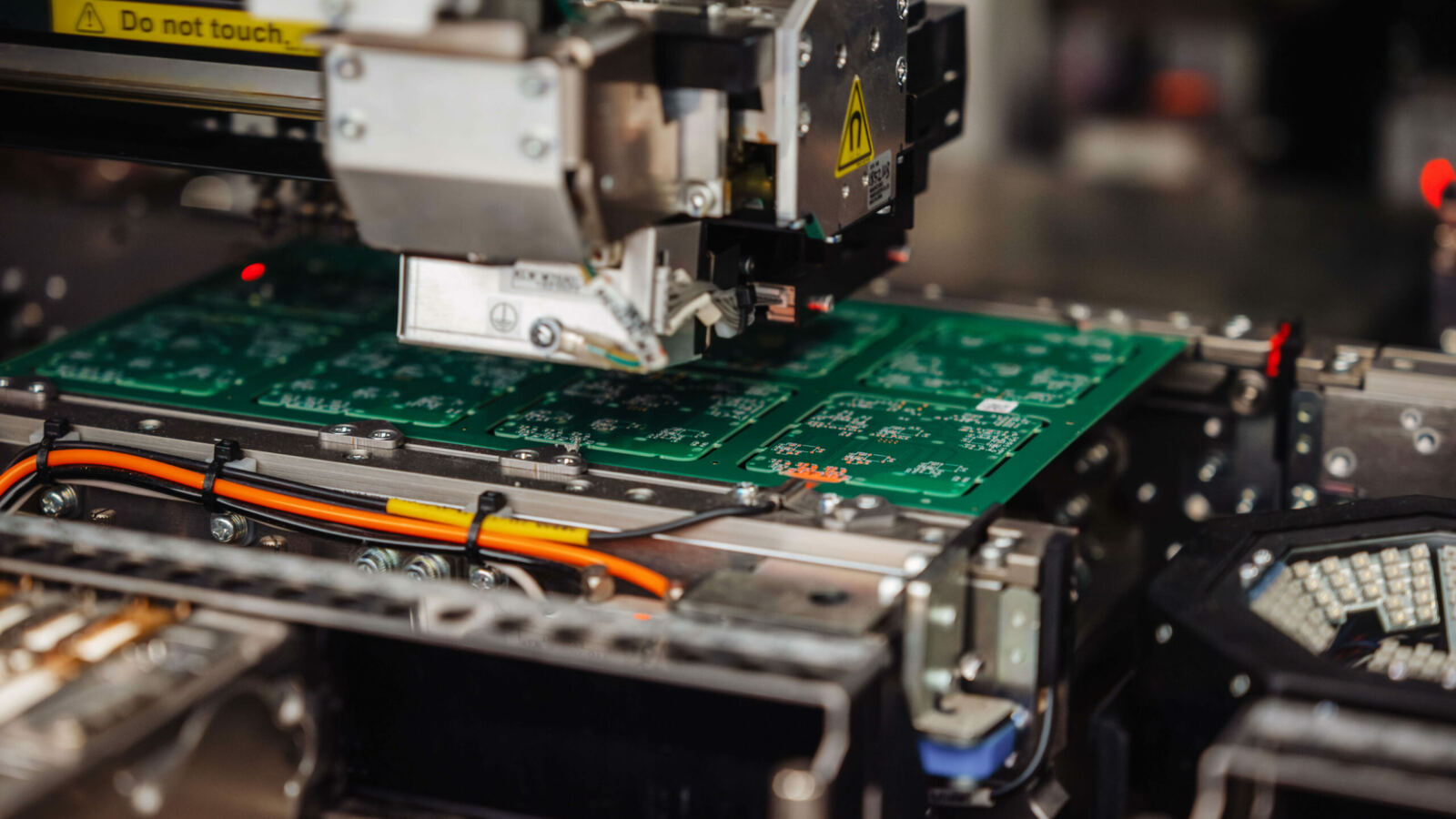
Contract manufacturers’ websites are full of vague phrases like “modern machine park”. Instead of taking their word for it, ask for specifics: which pick-and-place machines are on the shop floor, what the soldering process looks like, whether the company has its own optical inspection. In our case, SMD assembly runs exclusively on Yamaha machines, wave and selective soldering are carried out on ERSA equipment, and our reflow ovens are Heller. These are not exotic names but a proven industry standard, and that is exactly the kind of standard you should be asking about.
The best test is actually simple: ask to visit the production floor. A manufacturer with nothing to hide will gladly show you the shop floor, the component warehouse and the inspection stations. The way a company keeps its workplace tidy and organised is usually a good indication of how it will look after your product.
Quality you can prove
You will find the declaration “we care about quality” everywhere. The difference lies in whether there is a system behind it. Ask what exactly happens to a board after assembly: does every batch go through automated optical inspection (AOI), who verifies the issues flagged by the machine and how, and where the results are recorded.
The second pillar is traceability. If a customer files a complaint about a specific unit two years from now, the manufacturer should be able to reconstruct which component batch the device was built from, when it was assembled and how it performed in testing. At Convel we record all of this information in our ERP system, so if a problem ever arises we do not guess, we check.
Design support before production starts
A good contract manufacturer does not take documentation “as is”; it reads it first. A prototype that works on the bench is almost never ready for series production: there may be components nearing end of life, design choices that are hard to automate in assembly, or needlessly expensive parts where cheaper alternatives would do perfectly well.
That is why it pays to choose a company that, beyond assembly, offers genuine design support and production preparation. Reviewing the documentation before a series starts costs little and can save a great deal, both in component spend and in headaches during the first batches. We describe exactly what this process looks like, step by step, in our article on the road from prototype to series production.
Communication and distance matter
A price quote from far-off Asia can be tempting, but the maths gets less obvious once you add shipping, customs duties, capital tied up in large minimum order quantities and time zones that get in the way of quick responses. When a problem crops up mid-series, the difference between a manufacturer you can drive to across town and a partner who replies once a day can be the difference between a one-day stoppage and a delay of several weeks.
Convel has operated in Warsaw continuously since 1991, and over that time has manufactured devices for, among others, the medical, automotive, industrial automation and gas detection sectors. You can read more about our history and team on our about us page.
Questions worth asking before signing a contract
Finally, a short list you can treat as a cheat sheet for your first conversations:
- Which production stages do you carry out in-house, and which do you subcontract?
- What machines do you assemble on, and what does quality control look like after each stage?
- Can you trace the history of an individual unit by its serial number?
- What happens when a component from the documentation is no longer available?
- Can I come and see production in person?
- What support do you offer for the transition from prototype to series?
The answers to these questions will tell you more about your future collaboration than many a sales presentation. And if you would like to ask us, simply write or call. We will be happy to show you how we work.
Let's cost your project
Send us your BOM and Gerber files and we will prepare an assembly quote together with a proposed production schedule. We will also advise on what can be optimised in your design to reduce the unit cost.
Request a quote